
Приказ основних података о документу
Comparative Role of rGO, AgNWs, and rGO–AgNWs Hybrid Structure in the EMI Shielding Performance of Polyaniline/PCL-Based Flexible Films
| dc.creator | Gajić, Brankica | |
| dc.creator | Radoičić, Marija | |
| dc.creator | Yasir, Muhammad | |
| dc.creator | Saeed, Warda | |
| dc.creator | Bolka, Silvester | |
| dc.creator | Nardin, Blaž | |
| dc.creator | Potočnik, Jelena | |
| dc.creator | Ćirić-Marjanović, Gordana | |
| dc.creator | Šaponjić, Zoran | |
| dc.creator | Jovanović, Svetlana | |
| dc.date.accessioned | 2026-01-13T09:27:55Z | |
| dc.date.available | 2026-01-13T09:27:55Z | |
| dc.date.issued | 2025 | |
| dc.identifier.issn | 1420-3049 | |
| dc.identifier.uri | https://vinar.vin.bg.ac.rs/handle/123456789/16044 | |
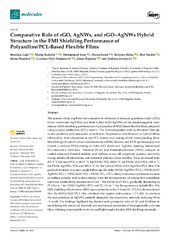
| dc.description.abstract | The present study explores the comparative influence of reduced graphene oxide (rGO), silver nanowires (AgNWs), and their hybrid rGO–AgNWs on the electromagnetic interference (EMI) shielding performance of polyaniline (PANI)-based flexible films prepared using a polycaprolactone (PCL) matrix. The nanocomposites were synthesized through in situ oxidative polymerization of aniline in the presence of individual or hybrid fillers, followed by their dispersion in the PCL matrix and casting of the corresponding films. Morphological and structural characterization (SEM, Raman, and FTIR spectroscopy) confirmed a uniform PANI coating on both rGO sheets and AgNWs, forming hierarchical 3D conductive networks. Thermal (TGA) and thermomechanical (TMA) analyses revealed enhanced thermal stability and stiffness across all composite systems, driven by strong interfacial interactions and restricted polymer chain mobility. Tmax increased from 437.9 °C for neat PCL to 487.9 °C for PANI/PCL, 480.6 °C for PANI/rGO/PCL, 499.4 °C for PANI/AgNWs/PCL and 495.0 °C for the hybrid PANI/rGO–AgNWs/PCL film. The gradual decrease in contact angle following the order PANI/AgNWs/PCL < PANI/rGO–AgNWs/PCL < PANI/rGO/PCL < PANI/PCL < PCL clearly indicates a systematic increase in surface polarity and surface energy with the incorporation of conductive nanofillers. Electrical conductivity reached 60.8 S cm−1 for PANI/rGO/PCL, gradually decreasing to 27.4 S cm−1 for PANI/AgNWs/PCL and 22.1 S cm−1 for the quaternary hybrid film. The EMI shielding effectiveness (SET) measurements in the X-band (8–12 GHz) demonstrated that the PANI/rGO/PCL film exhibited the highest attenuation (~7.2 dB). In contrast, the incorporation of AgNWs partially disrupted the conductive network, reducing SE to ~5–6 dB. The findings highlight the distinct and synergistic roles of 1D and 2D fillers in modulating the electrical, thermal, and mechanical properties of biodegradable polymer films, offering a sustainable route toward lightweight, flexible EMI shielding materials. | en |
| dc.language.iso | en | |
| dc.relation | info:eu-repo/grantAgreement/EC/HE/CSA/101079151/EU// | |
| dc.relation | info:eu-repo/grantAgreement/MESTD/inst-2020/200017/RS// | |
| dc.relation | info:eu-repo/grantAgreement/MESTD/inst-2020/200146/RS// | |
| dc.relation | info:eu-repo/grantAgreement/MESTD/inst-2020/200051/RS// | |
| dc.rights | openAccess | |
| dc.rights.uri | https://creativecommons.org/licenses/by/4.0/ | |
| dc.source | Molecules | |
| dc.subject | electromagnetic interference shielding | en |
| dc.subject | flexible films | en |
| dc.subject | hybrid nanocomposite | en |
| dc.subject | polyaniline | en |
| dc.subject | polycaprolactone | en |
| dc.subject | reduced graphene oxide | en |
| dc.subject | silver nanowires | en |
| dc.title | Comparative Role of rGO, AgNWs, and rGO–AgNWs Hybrid Structure in the EMI Shielding Performance of Polyaniline/PCL-Based Flexible Films | en |
| dc.type | article | en |
| dc.rights.license | BY | |
| dc.citation.volume | 30 | |
| dc.citation.issue | 24 | |
| dc.citation.spage | 4693 | |
| dc.identifier.doi | 10.3390/molecules30244693 | |
| dc.citation.rank | M21 | |
| dc.type.version | publishedVersion | |
| dc.identifier.scopus | 2-s2.0-105025969587 | |
| dc.identifier.fulltext | http://vinar.vin.bg.ac.rs/bitstream/id/45538/molecules-30-04693.pdf |
Документи
Овај документ се појављује у следећим колекцијама
-
Radovi istraživača
Researchers' publications -
GrInShield
[GrInShield] Twinning for new graphene based composites in electromagnetic interference shielding