| dc.creator | Sitarica, Pavle | |
| dc.creator | Vukadinović, Aleksandar | |
| dc.creator | Marić, Miloš | |
| dc.creator | Vranješ-Đurić, Sanja | |
| dc.creator | Stanković, Dalibor M. | |
| dc.creator | Perić, Marko | |
| dc.creator | Janković, Drina | |
| dc.creator | Stanković, Dragana | |
| dc.creator | Mirković, Marija D. | |
| dc.creator | Radović, Magdalena | |
| dc.date.accessioned | 2025-11-03T09:29:41Z | |
| dc.date.available | 2025-11-03T09:29:41Z | |
| dc.date.issued | 2025 | |
| dc.identifier.issn | 1422-0067 | |
| dc.identifier.uri | https://vinar.vin.bg.ac.rs/handle/123456789/15724 | |
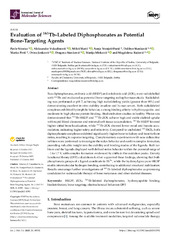
| dc.description.abstract | Two diphosphonates, etidronic acid (HEDP) and zoledronic acid (ZOL), were radiolabelled
with 161Tb and evaluated as potential bone-targeting radiopharmaceuticals. Radiolabeling was performed at pH 7, achieving high radiolabeling yields (greater than 98%) and
demonstrating excellent in vitro stability in saline and human serum. Both radiolabeled
complexes exhibited hydrophilic behavior, a strong binding affinity to hydroxyapatite, and
moderate to high plasma protein binding. Biodistribution studies in healthy Wistar rats
demonstrated that 161Tb-HEDP and 161Tb-ZOL achieve high and stable skeletal uptake
with rapid blood clearance and minimal soft tissue accumulation. 161Tb-HEDP favored
higher initial bone localization, while 161Tb-ZOL showed lower renal and hepatic accumulation, indicating higher safety and selectivity. Compared to unchelated 161TbCl3, both
diphosphonate complexes exhibited significantly higher bone-to-kidney and bone-to-liver
ratios, resulting in superior targeting. Complementary experiments with non-radioactive
terbium were performed to investigate the redox behavior and confirm complex formation,
providing valuable insight into the stability and binding modes of the ligands. Both terbium and the ligands displayed well-defined redox behavior within the potential range of
−1 to 1.7 V, with complex formation evidenced by shifts in the oxidation peaks. Density
functional theory (DFT) calculations further supported these findings, showing that both
phosphonate groups of a ligand coordinate to Tb3+, while the hydroxyl groups in HEDP
enable intermolecular hydrogen bonding, contributing to additional structural stabilization.
Results encourage further investigations of 161Tb-labeled diphosphonates as promising
candidates for radionuclide therapy of bone metastases and other skeletal diseases. | en |
| dc.language.iso | en | |
| dc.relation | info:eu-repo/grantAgreement/MESTD/inst-2020/200017/RS// | |
| dc.relation | info:eu-repo/grantAgreement/ScienceFundRS/Prizma2023_TT/7282/RS// | |
| dc.relation | Bilateral Serbia-NR China project [No. 003417078 2024 013440 003 000 620 021] | |
| dc.rights | openAccess | |
| dc.rights.uri | https://creativecommons.org/licenses/by/4.0/ | |
| dc.source | International Journal of Molecular Sciences | |
| dc.subject | HEDP | en |
| dc.subject | ZOL | en |
| dc.subject | 161Tb-labeled diphosphonates | en |
| dc.subject | hydroxyapatite binding | en |
| dc.subject | biodistribution | en |
| dc.subject | bone-targeting | en |
| dc.subject | electrochemical behavior | en |
| dc.subject | DFT | en |
| dc.title | Evaluation of 161Tb-Labeled Diphosphonates as Potential Bone-Targeting Agents | en |
| dc.type | article | en |
| dc.rights.license | BY | |
| dc.citation.volume | 26 | |
| dc.citation.issue | 21 | |
| dc.citation.spage | 10392 | |
| dc.identifier.doi | 10.3390/ijms262110392 | |
| dc.citation.rank | M21 | |
| dc.type.version | publishedVersion | |
| dc.identifier.fulltext | http://vinar.vin.bg.ac.rs/bitstream/id/44407/ijms-26-10392.pdf | |