
Приказ основних података о документу
The Erythrocyte Fatty Acid Profile in Multiple Sclerosis Is Linked to the Disease Course, Lipid Peroxidation, and Dietary Influence
| dc.creator | Stojković, Ljiljana | |
| dc.creator | Ranković, Slavica | |
| dc.creator | Dinčić, Evica | |
| dc.creator | Bošković, Maja | |
| dc.creator | Kolaković, Ana | |
| dc.creator | Seke, Mariana | |
| dc.creator | Takić, Marija | |
| dc.creator | Živković, Maja | |
| dc.date.accessioned | 2025-03-17T13:07:19Z | |
| dc.date.available | 2025-03-17T13:07:19Z | |
| dc.date.issued | 2025 | |
| dc.identifier.issn | 2072-6643 | |
| dc.identifier.uri | https://vinar.vin.bg.ac.rs/handle/123456789/14537 | |
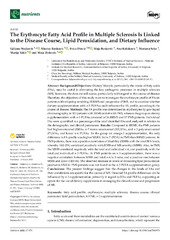
| dc.description.abstract | Background/Objectives: Dietary lifestyle, particularly the intake of fatty acids (FAs), may be useful in alleviating the key pathogenic processes in multiple sclerosis (MS); however, the data are still scarce, particularly with regard to the course of disease. Therefore, the objectives of this study were to investigate the erythrocyte profile of FAs in patients with relapsing-remitting (RR)MS and progressive (P)MS, and to examine whether dietary supplementation with n-3 PUFAs could influence the FA profile, according to the course of disease. Methods: The FA profile was determined in erythrocytes by gas–liquid chromatography, in 153 patients with RRMS and 69 with PMS, whereas the group on dietary supplementation with n-3 PUFAs consisted of 36 RRMS and 17 PMS patients. Individual FAs were quantified as a percentage of the total identified FAs and analyzed in relation to the demographic and clinical parameters. Results: Compared to RRMS, the PMS patients had higher saturated (S)FAs, n-7 mono-unsaturated (MU)FAs, and n-3 polyunsaturated (PU)FAs, and lower n-6 PUFAs. In the group on omega-3 supplementation, the only difference in FA profile was higher MUFA 16:1n-7 (POA) in PMS than RRMS patients. In PMS patients, there was a positive correlation of disability (EDSS) with the total SFA levels, whereby 16:0 (PA) correlated positively with EDSS and MS severity (MSSS). Also, in PMS, the MSSS correlated negatively with the total and individual n-6, and positively with the total and individual n-3 PUFAs. In PMS patients on n-3 supplementation, there was a negative correlation between MSSS and total n-6/n-3 ratio, and a positive one between MSSS and 22:6n-3 (DHA). The observed decrease in levels of circulating lipid peroxidation product 4-HNE in PMS patients was not found in the n-3 PUFA supplementation group. Conclusions: The present findings suggest that the changes in the levels of FAs and their correlations are specific for the course of MS. Detected FA profile differences can be influenced by n-3 supplementation, primarily in regard to SFAs and PUFAs, supporting an option for the use of dietary supplements in managing the clinical course and progression of MS. | en |
| dc.relation | info:eu-repo/grantAgreement/MESTD/inst-2020/200017/RS// | |
| dc.relation | info:eu-repo/grantAgreement/MESTD/inst-2020/200015/RS// | |
| dc.relation | info:eu-repo/grantAgreement/ScienceFundRS/Ideje/7753406/RS// | |
| dc.rights | openAccess | |
| dc.rights.uri | https://creativecommons.org/licenses/by/4.0/ | |
| dc.source | Nutrients | en |
| dc.subject | fatty acid profile | en |
| dc.subject | erythrocyte | en |
| dc.subject | multiple sclerosis | en |
| dc.subject | disease course | en |
| dc.subject | clinical parameter | en |
| dc.subject | lipid peroxidation | en |
| dc.subject | 4-HNE | en |
| dc.subject | n-3 supplementation | en |
| dc.title | The Erythrocyte Fatty Acid Profile in Multiple Sclerosis Is Linked to the Disease Course, Lipid Peroxidation, and Dietary Influence | en |
| dc.type | article | en |
| dc.rights.license | BY | |
| dc.citation.volume | 17 | |
| dc.citation.issue | 6 | |
| dc.citation.spage | 974 | |
| dc.identifier.doi | 10.3390/nu17060974 | |
| dc.citation.rank | M21 | |
| dc.type.version | publishedVersion | |
| dc.identifier.scopus | 2-s2.0-105001116521 | |
| dc.identifier.fulltext | http://vinar.vin.bg.ac.rs/bitstream/id/40686/nutrients-17-00974.pdf |
Документи
Овај документ се појављује у следећим колекцијама
-
Radovi istraživača
Researchers' publications -
FerroReg
[IDEJE] Identification and functional characterization of extracellular and intracellular genetic regulators of ferroptosis related processes in multiple sclerosis