
Приказ основних података о документу
Comparable Toxicity of Surface-Modified TiO2 Nanoparticles: An In Vivo Experimental Study on Reproductive Toxicity in Rats
| dc.creator | Todorović, Ana | |
| dc.creator | Bobić, Katarina | |
| dc.creator | Veljković, Filip | |
| dc.creator | Pejić, Snežana | |
| dc.creator | Glumac, Sofija | |
| dc.creator | Stanković, Sanja | |
| dc.creator | Milovanović, Tijana | |
| dc.creator | Vukoje, Ivana | |
| dc.creator | Nedeljković, Jovan | |
| dc.creator | Radojević Škodrić, Sanja | |
| dc.creator | Pajović, Snežana B. | |
| dc.creator | Drakulić, Dunja | |
| dc.date.accessioned | 2024-03-26T09:00:33Z | |
| dc.date.available | 2024-03-26T09:00:33Z | |
| dc.date.issued | 2024 | |
| dc.identifier.issn | 2076-3921 | |
| dc.identifier.uri | https://vinar.vin.bg.ac.rs/handle/123456789/13090 | |
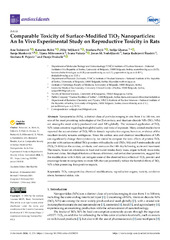
| dc.description.abstract | Nanoparticles (NPs), a distinct class of particles ranging in size from 1 to 100 nm, are one of the most promising technologies of the 21st century, and titanium dioxide NPs (TiO2 NPs) are among the most widely produced and used NPs globally. The increased application of TiO2 NPs raises concerns regarding their global safety and risks of exposure. Many animal studies have reported the accumulation of TiO2 NPs in female reproductive organs; however, evidence of the resultant toxicity remains ambiguous. Since the surface area and chemical modifications of NPs can significantly change their cytotoxicity, we aimed to compare the toxic effects of pristine TiO2 powder with surface-modified TiO2 powders with salicylic acid (TiO2/SA) and 5-aminosalicylic acid (TiO2/5-ASA) on the ovaries, oviducts, and uterus on the 14th day following acute oral treatment. The results, based on alterations in food and water intake, body mass, organ-to-body mass ratio, hormonal status, histological features of tissues of interest, and antioxidant parameters, suggest that the modification with 5-ASA can mitigate some of the observed toxic effects of TiO2 powder and encourage future investigations to create NPs that can potentially reduce the harmful effects of TiO2 NPs while preserving their positive impacts. | en |
| dc.relation | info:eu-repo/grantAgreement/MESTD/inst-2020/200017/RS// | en |
| dc.relation | info:eu-repo/grantAgreement/MESTD/inst-2020/200110/RS// | en |
| dc.relation | info:eu-repo/grantAgreement/ScienceFundRS/Prizma2023_TT/5354/RS// | |
| dc.rights | openAccess | |
| dc.rights.uri | https://creativecommons.org/licenses/by/4.0/ | |
| dc.source | Antioxidants | en |
| dc.subject | TiO2 | en |
| dc.subject | nanoparticles | en |
| dc.subject | chemical modifications | en |
| dc.subject | reproductive organs | en |
| dc.subject | toxicity | en |
| dc.subject | oxidative stress | en |
| dc.subject | hormonal status | en |
| dc.subject | rats | en |
| dc.title | Comparable Toxicity of Surface-Modified TiO2 Nanoparticles: An In Vivo Experimental Study on Reproductive Toxicity in Rats | en |
| dc.type | article | en |
| dc.rights.license | BY | |
| dc.citation.volume | 13 | |
| dc.citation.issue | 2 | |
| dc.citation.spage | 231 | |
| dc.identifier.wos | 001175068400001 | |
| dc.identifier.doi | 10.3390/antiox13020231 | |
| dc.citation.rank | M21p | |
| dc.type.version | publishedVersion | |
| dc.identifier.scopus | 2-s2.0-85187278976 | |
| dc.identifier.fulltext | http://vinar.vin.bg.ac.rs/bitstream/id/36158/bitstream_36158.pdf |
Документи
Овај документ се појављује у следећим колекцијама
-
Radovi istraživača
Researchers' publications -
HYDIS
[PRIZMA] Multifunctional visible-light-responsive inorganic-organic hybrids for efficient hydrogen production and disinfection