
Приказ основних података о документу
Intermittent Theta Burst Stimulation Improves Motor and Behavioral Dysfunction through Modulation of NMDA Receptor Subunit Composition in Experimental Model of Parkinson’s Disease
| dc.creator | Zeljković Jovanović, Milica | |
| dc.creator | Stanojević, Jelena | |
| dc.creator | Stevanović, Ivana | |
| dc.creator | Stekić, Anđela | |
| dc.creator | Bolland, Samuel J. | |
| dc.creator | Jasnić, Nebojša | |
| dc.creator | Ninković, Milica | |
| dc.creator | Zarić Kontić, Marina | |
| dc.creator | Ilić, Tihomir V. | |
| dc.creator | Rodger, Jennifer | |
| dc.creator | Nedeljković, Nadežda | |
| dc.creator | Dragić, Milorad | |
| dc.date.accessioned | 2023-06-19T08:38:00Z | |
| dc.date.available | 2023-06-19T08:38:00Z | |
| dc.date.issued | 2023 | |
| dc.identifier.issn | 2073-4409 | |
| dc.identifier.uri | https://vinar.vin.bg.ac.rs/handle/123456789/11099 | |
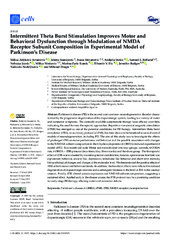
| dc.description.abstract | Parkinson’s disease (PD) is the second most common neurodegenerative disorder characterized by the progressive degeneration of the dopaminergic system, leading to a variety of motor and nonmotor symptoms. The currently available symptomatic therapy loses efficacy over time, indicating the need for new therapeutic approaches. Repetitive transcranial magnetic stimulation (rTMS) has emerged as one of the potential candidates for PD therapy. Intermittent theta burst stimulation (iTBS), an excitatory protocol of rTMS, has been shown to be beneficial in several animal models of neurodegeneration, including PD. The aim of this study was to investigate the effects of prolonged iTBS on motor performance and behavior and the possible association with changes in the NMDAR subunit composition in the 6-hydroxydopamine (6-OHDA)-induced experimental model of PD. Two-month-old male Wistar rats were divided into four groups: controls, 6-OHDA rats, 6-OHDA + iTBS protocol (two times/day/three weeks) and the sham group. The therapeutic effect of iTBS was evaluated by examining motor coordination, balance, spontaneous forelimb use, exploratory behavior, anxiety-like, depressive/anhedonic-like behavior and short-term memory, histopathological changes and changes at the molecular level. We demonstrated the positive effects of iTBS at both motor and behavioral levels. In addition, the beneficial effects were reflected in reduced degeneration of dopaminergic neurons and a subsequent increase in the level of DA in the caudoputamen. Finally, iTBS altered protein expression and NMDAR subunit composition, suggesting a sustained effect. Applied early in the disease course, the iTBS protocol may be a promising candidate for early-stage PD therapy, affecting motor and nonmotor deficits. © 2023 by the authors. | en |
| dc.language | English | |
| dc.relation | info:eu-repo/grantAgreement/MESTD/inst-2020/200178/RS// | |
| dc.relation | Ministry of Education, Science and Technological Development, Serbia [451-03-1/2021-16/14-0902102] | |
| dc.relation | University of Defence [Grant No. MFVMA/02/22-24] | |
| dc.rights | openAccess | |
| dc.rights.uri | https://creativecommons.org/licenses/by/4.0/ | |
| dc.source | Cells | |
| dc.subject | 6-OHDA | en |
| dc.subject | iTBS | en |
| dc.subject | neuroprotection | en |
| dc.subject | NMDA receptor | en |
| dc.subject | Parkinson’s disease | en |
| dc.subject | rTMS | en |
| dc.title | Intermittent Theta Burst Stimulation Improves Motor and Behavioral Dysfunction through Modulation of NMDA Receptor Subunit Composition in Experimental Model of Parkinson’s Disease | |
| dc.type | article | en |
| dc.rights.license | BY | |
| dc.citation.volume | 12 | |
| dc.citation.issue | 11 | |
| dc.identifier.wos | 001004491200001 | |
| dc.identifier.doi | 10.3390/cells12111525 | |
| dc.citation.rank | M21 | |
| dc.type.version | publishedVersion | |
| dc.identifier.scopus | 2-s2.0-85161413114 | |
| dc.identifier.fulltext | http://vinar.vin.bg.ac.rs/bitstream/id/29857/cells-12-01525.pdf |
Документи
Овај документ се појављује у следећим колекцијама
-
090 - Laboratorija za molekularnu biologiju i endokrinologiju
Department of Molecular Biology and Endocrinology -
Radovi istraživača
Researchers' publications