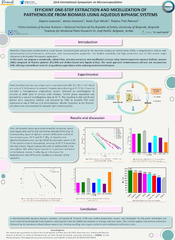
INTRODUCTION Feverfew (Tanacetum parthenium (L.) Sch. Bip.) is a well-known medicinal plant valued for its bioactive compound parthenolide (PAR), a sesquiterpene lactone with demonstrated anti-inflammatory, anticancer, and neuroprotective properties. However, the limited availability and high production cost of PAR remain major obstacles to its broader therapeutic application. Traditional extraction methods often rely on toxic organic solvents such as methanol or acetonitrile, raising environmental and safety concerns. There is a need for greener, safer, and more economical extraction methods that also preserve the potential synergies of PAR with other native bioactives. In this work, we propose a sustainable, solvent-free, one-step extraction and micellization process using thermoresponsive aqueous biphasic systems (ABS) composed of Pluronic 17R4 polymer and choline-based ionic liquids (ChILs). This novel approach simultaneously extracts and encapsulates PAR, offering a streamlined ro...ute for drug delivery applications while reducing environmental impact. EXPERIMENTAL METHODS Dried feverfew biomass was mixed with a pre-optimized ABS system composed of Pluronic 17R4, ChILs, and water at a ratio of 1:50 (biomass to solvent). Samples were gently mixed at 25 °C for 2 hours to maintain a homogeneous single-phase system, followed by centrifugation (5 minutes at 5000 rpm) to remove solid residues. Further phase separation was induced by a second centrifugation step at 35 °C. The resulting IL-rich and Pluronic-rich phases were collected, diluted, and analyzed by HPLC to quantify PAR yield, expressed as mg of PAR per g of dried biomass. Micelle formation in the Pluronic-rich phase was characterized via Dynamic Light Scattering (DLS). RESULTS AND DISCUSSION Key extraction parameters were optimized, including ABS composition, biomass-to-solvent ratio, and mixing conditions. The highest extraction yield of 2.52 mg PAR/g biomass was achieved with an ABS consisting of 25% Pluronic 17R4, 7% ChIL (choline lactate), and 68% water, using mild shaking at 100 rpm. Notably, micellization occurred concurrently with extraction, forming nanostructured micelles in the Pluronic-rich phase. DLS analysis revealed micelle sizes ranging from 113 to 187 nm, depending on the specific ChIL used. These results demonstrate the dual functionality of the developed ABS: efficient extraction of parthenolide and its in-situ micellization, which may enhance its bioavailability and delivery potential. Moreover, this method eliminates the need for harmful solvents, offering an environmentally responsible and scalable alternative for pharmaceutical-grade PAR production.
TY  - CONF
AU  - Lazarević, Dajana
AU  - Jovanović, Jelena
AU  - Ćujić Nikolić, Nada
AU  - Trtić-Petrović, Tatjana M.
PY  - 2025
UR  - https://vinar.vin.bg.ac.rs/handle/123456789/16063
AB  - INTRODUCTION Feverfew (Tanacetum parthenium (L.) Sch. Bip.) is a well-known medicinal plant valued for its bioactive compound parthenolide (PAR), a sesquiterpene lactone with demonstrated anti-inflammatory, anticancer, and neuroprotective properties. However, the limited availability and high production cost of PAR remain major obstacles to its broader therapeutic application. Traditional extraction methods often rely on toxic organic solvents such as methanol or acetonitrile, raising environmental and safety concerns. There is a need for greener, safer, and more economical extraction methods that also preserve the potential synergies of PAR with other native bioactives. In this work, we propose a sustainable, solvent-free, one-step extraction and micellization process using thermoresponsive aqueous biphasic systems (ABS) composed of Pluronic 17R4 polymer and choline-based ionic liquids (ChILs). This novel approach simultaneously extracts and encapsulates PAR, offering a streamlined route for drug delivery applications while reducing environmental impact. EXPERIMENTAL METHODS Dried feverfew biomass was mixed with a pre-optimized ABS system composed of Pluronic 17R4, ChILs, and water at a ratio of 1:50 (biomass to solvent). Samples were gently mixed at 25 °C for 2 hours to maintain a homogeneous single-phase system, followed by centrifugation (5 minutes at 5000 rpm) to remove solid residues. Further phase separation was induced by a second centrifugation step at 35 °C. The resulting IL-rich and Pluronic-rich phases were collected, diluted, and analyzed by HPLC to quantify PAR yield, expressed as mg of PAR per g of dried biomass. Micelle formation in the Pluronic-rich phase was characterized via Dynamic Light Scattering (DLS). RESULTS AND DISCUSSION Key extraction parameters were optimized, including ABS composition, biomass-to-solvent ratio, and mixing conditions. The highest extraction yield of 2.52 mg PAR/g biomass was achieved with an ABS consisting of 25% Pluronic 17R4, 7% ChIL (choline lactate), and 68% water, using mild shaking at 100 rpm. Notably, micellization occurred concurrently with extraction, forming nanostructured micelles in the Pluronic-rich phase. DLS analysis revealed micelle sizes ranging from 113 to 187 nm, depending on the specific ChIL used. These results demonstrate the dual functionality of the developed ABS: efficient extraction of parthenolide and its in-situ micellization, which may enhance its bioavailability and delivery potential. Moreover, this method eliminates the need for harmful solvents, offering an environmentally responsible and scalable alternative for pharmaceutical-grade PAR production.
PB  - VIVENDI project
T1  - Poster: Efficient One-Step Extraction and Micellization of Parthenolide From Biomass Using Aqueous Biphasic Systems
UR  - https://hdl.handle.net/21.15107/rcub_vinar_16063
ER  -
@conference{
author = "Lazarević, Dajana and Jovanović, Jelena and Ćujić Nikolić, Nada and Trtić-Petrović, Tatjana M.",
year = "2025",
abstract = "INTRODUCTION Feverfew (Tanacetum parthenium (L.) Sch. Bip.) is a well-known medicinal plant valued for its bioactive compound parthenolide (PAR), a sesquiterpene lactone with demonstrated anti-inflammatory, anticancer, and neuroprotective properties. However, the limited availability and high production cost of PAR remain major obstacles to its broader therapeutic application. Traditional extraction methods often rely on toxic organic solvents such as methanol or acetonitrile, raising environmental and safety concerns. There is a need for greener, safer, and more economical extraction methods that also preserve the potential synergies of PAR with other native bioactives. In this work, we propose a sustainable, solvent-free, one-step extraction and micellization process using thermoresponsive aqueous biphasic systems (ABS) composed of Pluronic 17R4 polymer and choline-based ionic liquids (ChILs). This novel approach simultaneously extracts and encapsulates PAR, offering a streamlined route for drug delivery applications while reducing environmental impact. EXPERIMENTAL METHODS Dried feverfew biomass was mixed with a pre-optimized ABS system composed of Pluronic 17R4, ChILs, and water at a ratio of 1:50 (biomass to solvent). Samples were gently mixed at 25 °C for 2 hours to maintain a homogeneous single-phase system, followed by centrifugation (5 minutes at 5000 rpm) to remove solid residues. Further phase separation was induced by a second centrifugation step at 35 °C. The resulting IL-rich and Pluronic-rich phases were collected, diluted, and analyzed by HPLC to quantify PAR yield, expressed as mg of PAR per g of dried biomass. Micelle formation in the Pluronic-rich phase was characterized via Dynamic Light Scattering (DLS). RESULTS AND DISCUSSION Key extraction parameters were optimized, including ABS composition, biomass-to-solvent ratio, and mixing conditions. The highest extraction yield of 2.52 mg PAR/g biomass was achieved with an ABS consisting of 25% Pluronic 17R4, 7% ChIL (choline lactate), and 68% water, using mild shaking at 100 rpm. Notably, micellization occurred concurrently with extraction, forming nanostructured micelles in the Pluronic-rich phase. DLS analysis revealed micelle sizes ranging from 113 to 187 nm, depending on the specific ChIL used. These results demonstrate the dual functionality of the developed ABS: efficient extraction of parthenolide and its in-situ micellization, which may enhance its bioavailability and delivery potential. Moreover, this method eliminates the need for harmful solvents, offering an environmentally responsible and scalable alternative for pharmaceutical-grade PAR production.",
publisher = "VIVENDI project",
title = "Poster: Efficient One-Step Extraction and Micellization of Parthenolide From Biomass Using Aqueous Biphasic Systems",
url = "https://hdl.handle.net/21.15107/rcub_vinar_16063"
}
Lazarević, D., Jovanović, J., Ćujić Nikolić, N.,& Trtić-Petrović, T. M.. (2025). Poster: Efficient One-Step Extraction and Micellization of Parthenolide From Biomass Using Aqueous Biphasic Systems.
VIVENDI project..
https://hdl.handle.net/21.15107/rcub_vinar_16063
Lazarević D, Jovanović J, Ćujić Nikolić N, Trtić-Petrović TM. Poster: Efficient One-Step Extraction and Micellization of Parthenolide From Biomass Using Aqueous Biphasic Systems. 2025;.
https://hdl.handle.net/21.15107/rcub_vinar_16063 .
Lazarević, Dajana, Jovanović, Jelena, Ćujić Nikolić, Nada, Trtić-Petrović, Tatjana M., "Poster: Efficient One-Step Extraction and Micellization of Parthenolide From Biomass Using Aqueous Biphasic Systems" (2025),
https://hdl.handle.net/21.15107/rcub_vinar_16063 .