
Приказ основних података о документу
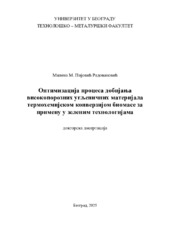
Оптимизација процеса добијања високопорозних угљеничних материјала термохемијском конверзијом биомасе за примену у зеленим технологијама
Optimization of the process of obtaining highly porous carbon materials by thermochemical conversion of biomass for application in green technologies
| dc.contributor.advisor | Pavićević, Vladimir | |
| dc.contributor.advisor | Janković, Bojan | |
| dc.contributor.other | Đolić, Maja | |
| dc.contributor.other | Pešić, Radojica | |
| dc.contributor.other | Ječmenica Dučić, Marija | |
| dc.creator | Pijović Radovanović, Milena M. | |
| dc.date.accessioned | 2025-10-23T18:43:53Z | |
| dc.date.available | 2025-10-23T18:43:53Z | |
| dc.date.issued | 2025 | |
| dc.identifier.uri | https://vinar.vin.bg.ac.rs/handle/123456789/15694 | |
| dc.description.abstract | Фокус ове докторске дисертације је на припреми и карактеризацији угљеничних материјала добијених из отпадне биомасе у функцији адсорбената за уклањање загађивача из водених раствора. Као сировине за синтезу коришћени су отпадне аутомобилске гуме на бази природног каучука, медвеђе грожђе као природни биљни материјал и кајсија као пољопривредни отпад. Угљенични материјали добијени су процесом пиролизе на температури од око 800 °C, а затим активирани употребом CO2 и H3PO4 у циљу побољшања порозне структуре и адсорпционих својстава. Испитиван је утицај параметара синтезе, на морфологију, специфичну површину и функционалне групе добијених материјала. Процеси адсорпције метала и органских боја из воде праћени су применом различитих аналитичких техника: инфрацрвена спектроскопија (FTIR) за идентификацију функционалних група, рендгенска дифракција (XRD) за одређивање кристалне структуре, Brunauer–Emmett–Teller анализа (BET) за мерење специфичне површине и порозности, и гасна хроматографија са масеном спектрометријом (GC-MS) за идентификацију и квантификацију органских загађивача. Резултати су показали да структура и хемијски састав угљеничних адсорбената значајно утичу на ефикасност уклањања различитих врста загађивача. Материјали добијени из природног и индустријског отпада показали су високу адсорпциону способност и потенцијал за примену у третману отпадних вода. Додатно, анализа економске и еколошке исплативости производње указује на могућност комерцијалне примене ових материјала у систему циркуларне економије. Према доступној литератури, синтеза и примена оваквих материјала из наведених извора до сада нису биле предмет обимнијег истраживања. | sr |
| dc.description.abstract | The focus of this doctoral dissertation is the preparation and characterization of carbon-based materials derived from waste biomass, intended for use as adsorbents for the removal of pollutants from aqueous solutions. The raw materials used for synthesis included waste automotive tires based on natural rubber, bearberry as a natural plant material, and apricot as agricultural waste. The carbon materials were obtained through pyrolysis at a temperature of approximately 800 °C, followed by activation using CO2 and H3PO4 to enhance their porous structure and adsorption properties. The influence of synthesis parameters on the morphology, specific surface area, and functional groups of the obtained materials was investigated. The adsorption processes of metals and organic dyes from water were monitored using various analytical techniques: Fourier-transform infrared spectroscopy (FTIR) for the identification of functional groups, X-ray diffraction (XRD) for determining crystalline structure, Brunauer–Emmett–Teller (BET) analysis for measuring specific surface area and porosity, and gas chromatography-mass spectrometry (GC-MS) for the identification and quantification of organic pollutants. The results showed that the structure and chemical composition of the carbon adsorbents significantly influence the efficiency of removing various types of pollutants. Materials obtained from both natural and industrial waste exhibited high adsorption capacity and potential for application in wastewater treatment. Additionally, an analysis of the economic and environmental feasibility of production indicates the possibility of commercial application of these materials within a circular economy system. According to the available literature, the synthesis and application of such materials from the mentioned sources have not previously been the subject of extensive research. | en |
| dc.format | application/pdf | |
| dc.language | sr | |
| dc.publisher | Универзитет у Београду, Технолошко-металуршки факултет | sr |
| dc.rights | openAccess | en |
| dc.rights.uri | https://creativecommons.org/licenses/by-nc-nd/4.0/ | |
| dc.source | Универзитет у Београду | sr |
| dc.subject | угљенични материјали | sr |
| dc.subject | карбонизација | sr |
| dc.subject | рециклажа | sr |
| dc.subject | тешки метали | sr |
| dc.subject | азо боја | sr |
| dc.subject | специфична површина | sr |
| dc.subject | биомаса | sr |
| dc.subject | карактеризација | sr |
| dc.subject | Carbon materials | en |
| dc.subject | Carbonization | en |
| dc.subject | Recycling | en |
| dc.subject | Heavy metal ions | en |
| dc.subject | Azo dye | en |
| dc.subject | Surface properties | en |
| dc.subject | Biomass | en |
| dc.subject | Characterization | en |
| dc.title | Оптимизација процеса добијања високопорозних угљеничних материјала термохемијском конверзијом биомасе за примену у зеленим технологијама | sr |
| dc.title.alternative | Optimization of the process of obtaining highly porous carbon materials by thermochemical conversion of biomass for application in green technologies | en |
| dc.type | doctoralThesis | en |
| dc.rights.license | BY-NC-ND | |
| dc.identifier.fulltext | http://vinar.vin.bg.ac.rs/bitstream/id/44284/bitstream_44284.pdf | |
| dc.identifier.fulltext | http://vinar.vin.bg.ac.rs/bitstream/id/44283/bitstream_44283.pdf | |
| dc.identifier.rcub | https://hdl.handle.net/21.15107/rcub_vinar_15694 |
Документи
Овај документ се појављује у следећим колекцијама
-
Doktorske teze
-
Radovi istraživača
Researchers' publications